March 30th, 2026
Introducing GUI‑Based Imaging Workflows in Data Studio
General
This release adds Graphical User Interface (GUI) based visualization tools to Data Studio, enabling researchers to work with complex imaging data directly on the platform. OHIF Viewer, 3D Slicer, and ImageJ can now be launched as cloud-hosted, desktop-like applications from Data Studio or from the Files tab, without local installation or configuration. Annotated outputs and result files from 3D Slicer and ImageJ can be exported back to the project workspace for downstream analysis.
New features
GUI-based imaging tools in Data Studio (OHIF Viewer, 3D Slicer, ImageJ)
Data Studio now supports Graphical User Interface (GUI) GUI-based imaging applications, enabling advanced visualization and annotation workflows alongside existing code-based environments such as JupyterLab and RStudio. OHIF Viewer, 3D Slicer, and ImageJ are available directly from the Create new analysis dialog in Data Studio, and from the Files tab via Open in Data Studio → Create new analysis, providing a consistent launch experience across both entry points. As part of this update, the existing SlicerJupyter (Beta) a remains available, with the new GUI 3D Slicer added alongside it.
The following capabilities are available when working with these tools:
- Custom extensions and plugins can be installed for OHIF Viewer, 3D Slicer, and ImageJ, with changes persisted and available on session restart.
- Annotated outputs and result files from 3D Slicer and ImageJ can be exported back to the project workspace for downstream analysis.
- Access to external data sources, including external repositories and data endpoints, is available subject to the project’s network access settings.
- GPU-enabled instance types are available for compute-intensive imaging workloads.
- Multi-cloud provider selection is supported to help minimize data egress costs.
Resources
To learn more about enabling GUI-based imaging tools for your organization or to get help planning a migration of existing imaging workflows, please contact your Velsera Seven Bridges representative or reach out to the Seven Bridges support team at [support@velsera.com].
March 25th, 2026
Recently published apps
General
DeepVariant workflow is an analysis pipeline that uses a deep neural network to call genetic variants from NGS DNA sequencing data. It is a highly accurate variant caller for ONT, PacBio, and multi-technology categories. It was updated from version 1.5.0 to 1.9.0.
Giraffe-DeepVariant workflow is a pipeline for calling small variants using the pangenome reference. Giraffe-DeepVariant workflow starts with sequenced reads (FASTQs, CRAM) and does analysis to detect small variants (VCF). Reads are mapped to a pangenome with vg giraffe and pre-processed (e.g. indel realignment) before the variant calling step. DeepVariant is used for calling small variants. It was updated from version 1.0 to 1.1.
Genotype GVCFs & Filter Variants workflow performs the main part of the Joint Discovery analysis of GATK. It starts with GVCF files, performs joint genotyping and gives back filtered vcf files. All independent tools of the workflow were upgraded to GATK 4.6.2.0 version.
nnUNet (nonewUNet) toolkit is a fully automated, self-configuring deep learning framework for biomedical image segmentation. It eliminates manual architecture engineering by automatically adapting itself to any new dataset. It analyzes dataset properties, configures all training components, and delivers strong baseline performance without human tuning.
Below is the list of tools included in this toolkit, arranged in an nnUNetstyle workflow.
1 .nnUNetv2 convert_MSD_dataset tool converts a Medical Segmentation Decathlon (MSD) dataset into the standardized nnUNet folder structure. It generates a valid dataset.json and restructures images/labels according to nnUNet conventions.
2 . nnUNetv2 plan_and_preprocess tool analyzes dataset properties (voxel spacing, intensity statistics, modalities) and generates the experiment plan that determines patch size, architecture, and configuration. It performs preprocessing steps like:
- Resampling
- Normalization
- Cropping
- Dataset caching
3 .nnUNetv2 train tool initiates model training for a given configuration (e.g. 2d, 3d_fullres) and fold (0–4).
The training includes data augmentation, optimization, checkpointing, and validation to produce trained model weights.
4 .nnUNetv2 find_best_config tool aggregates cross validation results and identifies the best performing configuration and checkpoint. It is used to decide which model or ensemble should be deployed for test time inference.
5 .nnUNetv2 predict tool runs inference on unseen images using the selected trained model which gives following outputs:
- Segmentation masks
- Optional probability maps
6 .nnUNetv2 determine_postprocessing tool evaluates several postprocessing heuristics (e.g. removing small, connected components) on validation outputs.It automatically selects the rule set that improves performance metrics such as Dice and IoU.
7 .nnUNetv2 apply_postprocessing tool applies the chosen postprocessing operations to raw prediction outputs to refine segmentation masks and enhance overall accuracy.
8 .nnUNetv2 ensemble tool combines predictions from multiple folds or configurations (e.g. 2D + 3D) by averaging their probability maps. Itensembles which improves robustness and generally increases accuracy.
9 .nnUNetv2 evaluate_folder tool computes metrics by comparing a folder of predicted labels with groundtruth labels (e.g., Dice, IoU, depending on configuration). It summarizes percase and aggregate scores, enabling quick validation of model performance or comparison across checkpoints, folds, or ensembles.
Resources
If you need help with accessing controlled study details, please contact your Velsera Seven Bridges representative or email [support@velsera.com].
February 20th, 2026
Enhanced Data Studio Session Backup and Shutdown
General
This release includes stability enhancements to Data Studio session shutdown and backup, reducing the occurrence of stuck sessions and improving the reliability of analysis recovery.
Improvements
The reliability of the process that runs when you stop a Data Studio session has been improved. The updated logic better handles large and complex analysis environments, ensuring that backup and cleanup steps complete more consistently before a session is terminated.
Fixed Bugs
Several issues that could cause Data Studio sessions to remain in a saving or stopping state for extended periods and result in incomplete backups have been resolved. The following underlying problems were fixed:
- Locked files during backup: Improved handling of files that remain in use while the backup is running, so they no longer prevent proper cleanup and completion of the backup process.
- File upload reliability: Strengthened error handling for timeouts when uploading large files, reducing incomplete transfers that could interrupt session backup.
- Complex environment handling: Fixed failures when saving sessions with many installed packages and dependencies, improving stability for complex analysis environments.
- System metrics handling: Fixed an issue where unexpected internal data could interrupt the backup workflow.
- Bulk file operations: Optimized how large batches of files are processed during backup, preventing platform slowdowns during session shutdown.
Resources
If you experience issues with stopping or recovering a Data Studio session, please contact your Velsera Seven Bridges representative or email support@velsera.com.
Learn more about Data Studio.
December 18th, 2025
Recently Published Apps
- CellTypist: Automated cell type annotation in single-cell RNA-seq data. It uses pre-trained machine learning models on curated datasets to deliver fast, standardized, and reproducible cell labeling. This is especially valuable for large-scale immunology and tissue profiling studies, reducing manual effort and subjectivity.
- GATK VariantToTable: Transform raw VCF data into clean, structured tables. Select the INFO, FORMAT, or genotype fields you need, and the tool generates a ready-to-use CSV/TSV file for effortless filtering, visualization, and downstream analysis in Excel, R, and Python.
- GATK GenomicsDBImport: Efficiently combine multiple gVCF files into a GenomicsDB workspace, enabling scalable joint genotyping. It organizes variant data in a tiled database format, which allows faster queries and reduces storage requirements compared to raw gVCFs. This step is typically performed before running GenotypeGVCFs in large cohort analyses. The updated version 4.6.2.0, now featuring a DB update option.
- The MCmicro workflow: A scalable and reproducible pipeline for processing multiplexed tissue imaging data. It integrates tools for image registration, illumination correction, segmentation, and feature extraction. These tools produce high-quality single-cell spatial datasets and are designed for large-scale studies, MCmicro standardizes analysis across experiments, enabling downstream biological insights from multiplex imaging platforms. This updated workflow version, with existing models and support for custom models.
November 4th, 2025
Enable Project Download Restrictions Retroactively
This release introduces the ability to apply download restrictions to a project retroactively. Previously, the download restriction could only be applied while creating a project. With this release, the admins and project creator can modify the project settings to enable download restrictions at anytime.
The Download Restriction feature has been upgraded to also be applicable retroactively to existing projects, without recreating projects or migrating files. This enables enhanced restriction of data access on the platform, aligning with security policies.
- The restriction is irreversible, ensuring consistent security policies.
- Internal teams can support rollback based on requests, ensuring flexibility without compromising control and reducing time
November 4th, 2025
Enabling new AWS families with GPU-enabled Instances on Data Studio
This release introduces adding new AWS families with GPU enabled Instances within Seven Bridges Data Studio. It enables users to perform advanced medical image visualization, segmentation, GPU acceleration and secure data integration.
Enabled AWS Instances on Data Studio
We are thrilled to announce that we have enabled new AWS families with GPU enabled Instances on Data Studio to provide even more options for optimizing your computational workloads.
New AWS Instance Families Include:
- Compute-Optimized: C7i, C6i
- Memory-Optimized: R7i, R7iz, R6i, R6in, X2idn, X2iedn, X2iezn
- General Purpose: M7i, M6i
- GPU-Enabled: G6, G5
This update empowers researchers and analysts to execute high-performance computational tasks directly from Data Studio without external infrastructure setup.
It simplifies workflow execution, reducing processing time and improving efficiency for GPU-dependent applications.
November 4th, 2025
3D Slicer now available in Data Studio
General
This release introduces 3D Slicer as a fully integrated analysis environment within Data Studio, enabling advanced medical image visualization and segmentation.
New feature
3D Slicer can now be launched directly from Data Studio for interactive medical imaging and 3D visualization workflows, with the option of GPU-powered compute instances for high-performance rendering. This release enables you to perform entire imaging workflows from data import, visualization, annotation within the secure and compliant Seven Bridges platform, and eliminates the need to move sensitive data across multiple tools or local machines.
October 30th, 2024
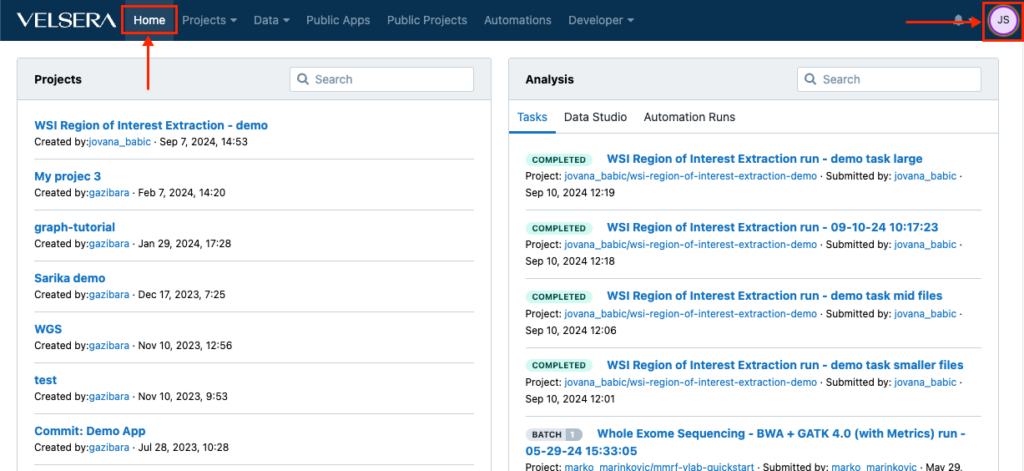
Changes in the main navigation
The main navigation now features a Home button which returns you to the dashboard at any given point. In addition, the icon for accessing the account settings now shows your initials instead of the username.
Improved UX for Enterprise users
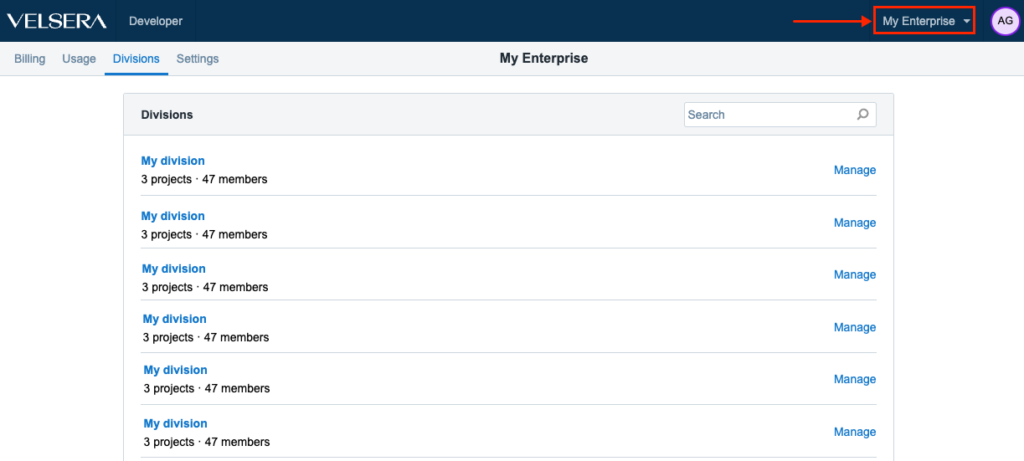
We have introduced a small change in order to improve and optimize the UX for the Enterprise users. The menu for accessing Divisions is now in the upper right hand side, right next to the Account Settings.
October 28th, 2024
Nextflow – enhanced execution and scalability
We’re excited to announce powerful new features to enhance Nextflow performance, scalability, and resource optimization. These updates streamline workflow execution and expand support for advanced configurations, making it easier than ever to manage complex pipelines.
Multi-Instance Execution
Support for multi-instance execution allows Nextflow workflows to leverage multiple instances concurrently. This improvement enables increased parallelism and better resource utilization across workflows, resulting in significant performance boosts for complex or large-scale data pipelines.
Memoization (Work Reuse)
Introducing memoization for workflow tasks, allowing Nextflow to reuse previous results, significantly reducing compute time and resource usage. This feature is especially beneficial for iterating on workflows with minor changes, as previously executed tasks are reused when input data and parameters remain consistent.
Elastic Disk Support
Elastic disk capability allows dynamic scaling of disk resources based on workflow requirements. This flexible storage management ensures that high-demand workflows have access to the necessary storage without manual intervention, optimizing both performance and cost.
Instance Hints for Optimized Resource Selection
Nextflow now supports instance hints to provide tailored recommendations for instance types based on workflow needs. These hints help reduce costs and improve runtime efficiency by selecting the most suitable instance types for different tasks.
Real-Time Job Monitoring for Worker Instances
Enhanced job monitoring capabilities provide real-time insights into the status of worker instances. Users can monitor task progress and troubleshoot issues as they arise, leading to faster adjustments and a more seamless workflow execution experience.
Compatibility with All Nextflow Executor Versions (Post 21.10.0)
Full support for all Nextflow executor versions after 21.10.0 allows users to run workflows with the exact executor version they need, ensuring compatibility and reproducibility across executions. This enhancement allows teams to replicate their work consistently while taking advantage of continuous improvements in Nextflow ecosystem.